Best Strategy to Prepare Quantitative Aptitude for SSC CGL
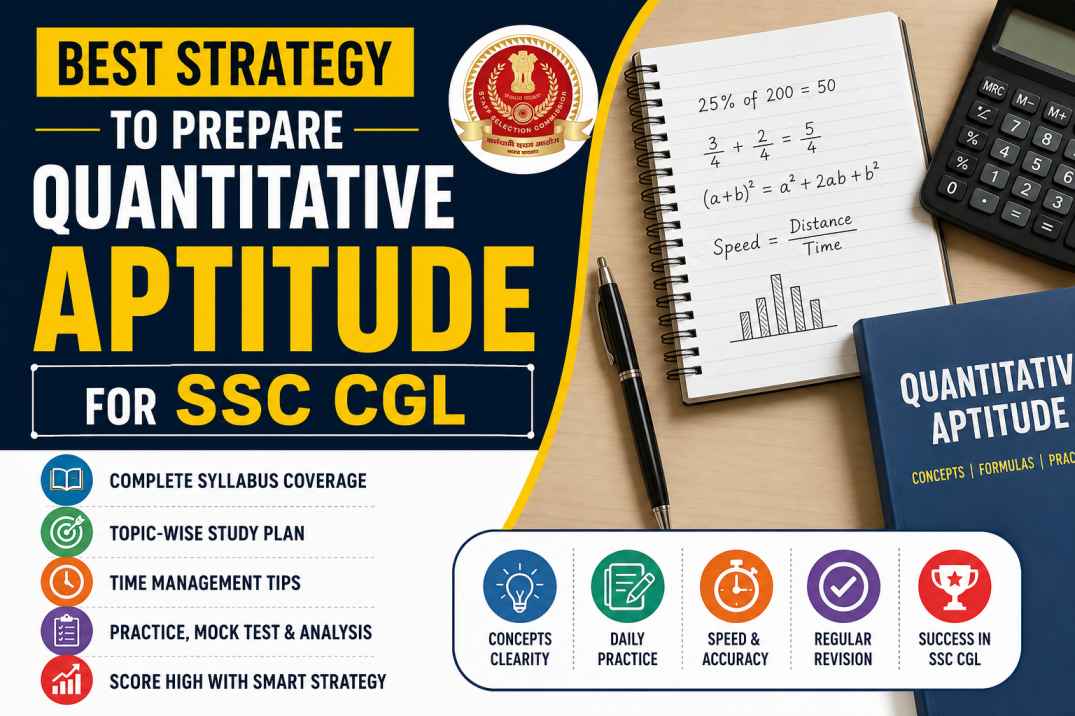
Best Strategy to Prepare Quantitative Aptitude for SSC CGL
Quantitative Aptitude is one of the most important sections of the SSC CGL examination. It is also considered one of the most scoring subjects if prepared with the right strategy. Every year, thousands of aspirants struggle with mathematics because they focus only on solving questions instead of building strong concepts.
The truth is that Quantitative Aptitude is not difficult. It requires conceptual clarity, regular practice, proper revision, and smart time management. Candidates who consistently practice previous year questions, revise formulas, and analyze their mistakes often score much higher than those who simply study for long hours.
In this article, you will learn the best strategy to prepare Quantitative Aptitude for SSC CGL, whether you are a beginner or an experienced aspirant.
Understand the SSC CGL Quant Syllabus
The first step in preparation is understanding the complete syllabus. Many students waste time studying unnecessary topics that are not asked in the examination.
The important topics include:
- Number System
- Simplification
- Percentage
- Ratio and Proportion
- Average
- Profit and Loss
- Simple Interest
- Compound Interest
- Time and Work
- Pipes and Cisterns
- Time, Speed and Distance
- Boats and Streams
- Mixture and Alligation
- Algebra
- Geometry
- Mensuration
- Trigonometry
- Statistics
- Data Interpretation
Knowing the syllabus helps you prepare in a systematic way.
Build Strong Concepts
One of the biggest mistakes beginners make is memorizing shortcut tricks without understanding the concepts.
Always begin with the basics. Learn why formulas work instead of simply memorizing them. Once your concepts are clear, solving difficult questions becomes much easier.
A strong foundation also helps when solving tricky questions in mock tests and previous year papers.
Follow a Topic-Wise Study Plan
Instead of studying random chapters every day, complete one topic before moving to the next.
A recommended order is:
- Percentage
- Ratio and Proportion
- Average
- Profit and Loss
- Simple and Compound Interest
- Time and Work
- Time, Speed and Distance
- Mixture and Alligation
- Algebra
- Geometry
- Mensuration
- Trigonometry
- Statistics
- Data Interpretation
This sequence allows you to build concepts gradually because many advanced topics depend on basic arithmetic.
Practice Previous Year Questions
Previous Year Questions (PYQs) are one of the best resources for SSC CGL preparation.
They help you understand:
- The exam pattern
- Frequently asked concepts
- Difficulty level
- Important question types
- Time management
Try to solve at least the last five to ten years of SSC CGL Quant papers. Repeat important questions until you can solve them confidently.
Improve Your Calculation Speed
Fast calculations can save valuable time during the examination.
Practice daily:
- Multiplication tables
- Squares up to 40
- Cubes up to 20
- Square roots
- Percentage calculations
- Fraction to percentage conversions
- Division shortcuts
Even 20 minutes of daily calculation practice can improve your overall speed significantly.
Learn Shortcut Techniques
Shortcut methods are useful, but they should only be learned after understanding the concepts.
Never depend completely on tricks.
First solve questions using the standard method. Once you become comfortable, learn faster approaches for common question types.
Remember this formula for success:
Concept + Practice + Shortcuts = High Score
Solve Mock Tests Regularly
Mock tests are essential because they simulate the real examination.
Benefits of mock tests include:
- Better speed
- Improved accuracy
- Stronger time management
- Increased confidence
- Reduced exam stress
Initially, solve one sectional mock test every week.
Later, increase your practice to:
- Two or three sectional mocks every week
- One full-length mock test every week
Always analyze your mistakes after every mock.
Maintain an Error Notebook
An error notebook is one of the most valuable tools for improvement.
Whenever you make a mistake, write down:
- The question
- The correct solution
- The concept involved
- The reason for the mistake
Revise this notebook every week. It will help you avoid repeating the same mistakes.
Revise Regularly
Revision is essential because concepts and formulas are easily forgotten.
A simple weekly revision plan can be:
- Monday to Friday: Learn new topics
- Saturday: Revise all topics studied during the week
- Sunday: Solve mock tests and previous year papers
Consistent revision improves memory and confidence.
Focus on Accuracy Before Speed
Many beginners try to solve questions quickly and end up making careless mistakes.
Your first goal should be achieving high accuracy.
Once your accuracy reaches around 90%, start working on improving speed.
Remember that negative marking can significantly reduce your final score.
Daily Study Plan for Quant
Here is a sample daily routine:
- 30 minutes for formula revision
- 60 minutes for learning new concepts
- 90 minutes for topic-wise practice
- 45 minutes for previous year questions
- 30 minutes for calculation practice
- 30 minutes for mistake analysis
Following this routine consistently can produce excellent results over time.
Common Mistakes to Avoid
Avoid these common mistakes during your preparation:
- Ignoring basic concepts
- Skipping revision
- Depending only on shortcut tricks
- Not solving previous year papers
- Giving mock tests without analysis
- Studying too many books at the same time
- Ignoring Geometry and Trigonometry
Avoiding these mistakes can improve your score considerably.
Best Tips to Score High in Quant
- Complete one chapter before starting another.
- Revise formulas every day.
- Solve at least 50 to 100 questions daily.
- Practice previous year questions regularly.
- Attempt mock tests every week.
- Analyze every mistake carefully.
- Stay consistent and avoid long study breaks.
Consistency is more important than studying for long hours occasionally.
Final Thoughts
Quantitative Aptitude is one of the highest-scoring sections in SSC CGL if prepared correctly. Instead of searching for shortcuts or magical tricks, focus on building strong concepts, practicing daily, revising regularly, and learning from your mistakes.
Remember that success in Quant is not achieved overnight. Small daily improvements, consistent practice, and disciplined preparation can help you achieve an excellent score in the SSC CGL examination.
Stay patient, trust your preparation, and continue improving every day.
Frequently Asked Questions (FAQs)
1. Is Quantitative Aptitude difficult for SSC CGL?
No. With proper concepts, regular practice, and revision, it becomes one of the easiest and highest-scoring sections.
2. How many questions should I practice daily?
You should aim to solve at least 50 to 100 quality questions every day.
3. Are previous year papers enough for Quant preparation?
Previous year papers are extremely important, but they should be combined with concept-building and mock tests for the best results.
4. How much time should I spend on Quant every day?
Most aspirants should dedicate around 2 to 4 hours daily, depending on their preparation level.
5. Can I score full marks in SSC CGL Quant?
Yes. Many candidates score exceptionally well by mastering concepts, practicing consistently, and maintaining high accuracy throughout their preparation.