How to Analyze SSC CGL Mock Tests to Improve Your Score (2026 Guide)
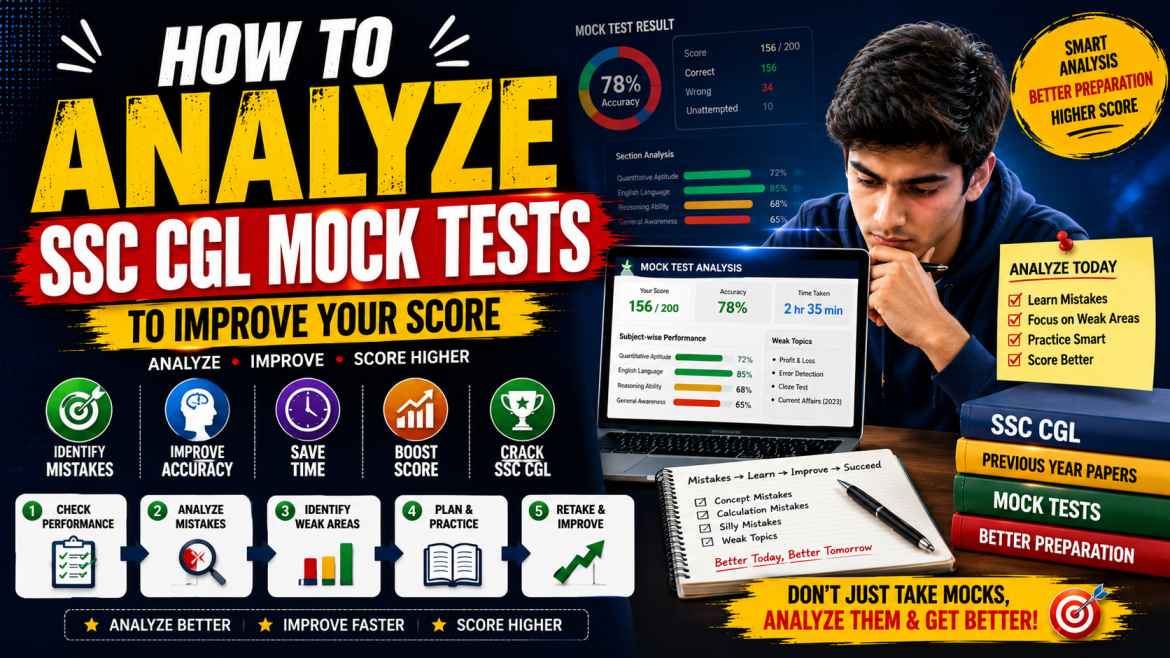
Taking mock tests is an essential part of SSC CGL preparation, but simply attempting one mock after another is not enough. Many aspirants take dozens of mock tests without seeing any improvement because they skip the most important step—analysis.
The real improvement begins after you finish the test. By analyzing your performance, identifying mistakes, and working on weak areas, you can steadily improve your speed, accuracy, and overall score.
In this guide, you'll learn how to analyze SSC CGL mock tests effectively and turn every mock test into a valuable learning opportunity.
Why Is Mock Test Analysis Important?
A mock test shows your current preparation level, but the analysis tells you how to improve.
Proper mock test analysis helps you:
- Identify weak subjects and topics
- Improve speed and accuracy
- Reduce negative marking
- Build confidence
- Track your progress over time
Remember, one well-analyzed mock test is often more valuable than five poorly reviewed mock tests.
Step 1: Don't Check Only Your Score
Many students look at the final score and immediately start another mock test.
Instead, ask yourself:
- Which section took the most time?
- Which subject had the highest accuracy?
- Where did I lose marks?
- Which questions should I have skipped?
The score is only one part of the story.
Step 2: Categorize Every Mistake
Create three categories for incorrect questions:
Concept Mistakes
You didn't know the concept or formula.
Solution: Revise the topic and solve similar questions.
Calculation Mistakes
You knew the concept but made a calculation error.
Solution: Practice calculations and slow down slightly.
Silly Mistakes
Examples include:
- Reading the wrong option
- Marking the wrong answer
- Ignoring words like NOT, EXCEPT, or ONLY
Solution: Read every question carefully before answering.
Step 3: Measure Your Accuracy
Accuracy is more important than attempting every question.
Use this formula:
Accuracy (%) = (Correct Answers ÷ Attempted Questions) × 100
Aiming for 90–95% accuracy is generally a better strategy than attempting too many questions with frequent mistakes.
Step 4: Track Time Spent on Each Section
Analyze how much time you spent on:
- Quantitative Aptitude
- English
- Reasoning
- General Awareness
If one section consistently takes too long, practice that section under timed conditions.
Step 5: Maintain an Error Notebook
An error notebook is one of the best revision tools.
Write down:
- Incorrect questions
- Important formulas
- Grammar rules
- Shortcuts
- Frequently repeated mistakes
Revise this notebook every week.
Step 6: Identify Weak Topics
Instead of saying:
"I'm weak in Maths."
Be specific:
- Algebra
- Geometry
- Trigonometry
- Profit & Loss
- Percentage
Similarly, identify weak areas in English, Reasoning, and General Awareness.
Focused improvement is much more effective than random practice.
Step 7: Reattempt Incorrect Questions
After revising a topic, solve the incorrect questions again without looking at the answers.
If you can solve them correctly the second time, it shows that you have learned from your mistakes.
Step 8: Compare Mock Test Performance
Keep a record of every mock test.
Track:
- Date
- Score
- Accuracy
- Time taken
- Weak sections
- Improvement areas
This helps you measure your progress objectively.
Daily Mock Test Analysis Routine
After each mock test:
- Spend 30–45 minutes reviewing incorrect answers.
- Revise weak concepts.
- Update your error notebook.
- Practice 10–20 similar questions.
- Plan the next day's revision.
Analysis should always be part of your study schedule.
Common Mistakes Students Make
Avoid these common habits:
- Taking multiple mock tests without analysis.
- Ignoring incorrect answers.
- Focusing only on the final score.
- Changing study resources after every mock.
- Not revising weak topics.
These mistakes slow down your improvement.
Tips to Improve Your Score
- Take one full-length mock test every week (increase frequency before the exam).
- Analyze every mistake carefully.
- Revise formulas regularly.
- Solve previous year papers alongside mock tests.
- Focus on improving one weak topic at a time.
- Maintain consistency.
Small improvements after every mock test lead to significant score increases over time.
Frequently Asked Questions (FAQs)
How long should I spend analyzing a mock test?
Ideally, spend 30–60 minutes analyzing each full-length mock test.
Is taking more mock tests always better?
No. Quality matters more than quantity. Every mock test should be followed by proper analysis.
What is a good accuracy rate in SSC CGL?
An accuracy of 90% or above is generally considered excellent and helps reduce negative marking.
Should I solve the same mock test again?
You don't need to repeat the entire mock, but you should definitely reattempt the questions you answered incorrectly.
Final Thoughts
Mock tests are not just for checking your score—they are powerful learning tools. Every incorrect answer is an opportunity to improve. By analyzing your performance, maintaining an error notebook, revising weak topics, and tracking your progress, you can steadily increase both your speed and accuracy.
Success in SSC CGL comes from consistent improvement, not perfection. Make mock test analysis a regular habit, and you'll see your confidence and scores improve with every attempt.