How to Avoid Negative Marking in SSC CGL: Smart Attempt Strategy (2026 Guide)
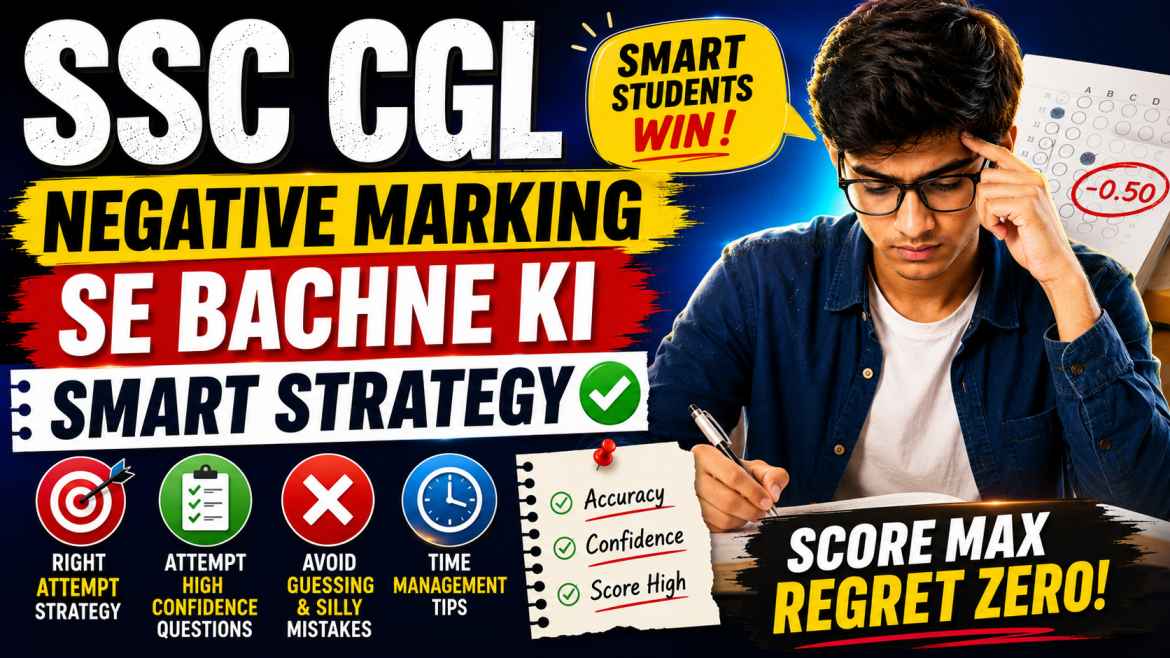
Negative marking is one of the biggest reasons why many SSC CGL aspirants fail to achieve their target score. Even after studying hard, candidates often lose valuable marks by making unnecessary guesses or careless mistakes.
The good news is that negative marking can be reduced with the right attempt strategy. In this guide, you'll learn practical techniques to improve your accuracy, avoid common mistakes, and maximize your SSC CGL score.
What Is Negative Marking in SSC CGL?
In the SSC CGL examination, every incorrect answer results in a deduction of marks. This means that answering questions without proper confidence can reduce your overall score.
Instead of attempting every question, your goal should be to maximize correct answers while minimizing wrong answers.
Why Do Students Lose Marks?
Most candidates lose marks because they:
- Guess answers without confidence.
- Misread the question.
- Ignore keywords like NOT, EXCEPT, and ONLY.
- Spend too much time on difficult questions.
- Panic during the exam.
- Make calculation mistakes.
- Change correct answers at the last moment.
Understanding these mistakes is the first step toward avoiding them.
Smart Attempt Strategy for SSC CGL
Step 1: Attempt Easy Questions First
Start your exam with questions that you can solve confidently.
Benefits:
- Builds confidence.
- Saves time.
- Increases accuracy.
- Reduces exam pressure.
Never begin with the toughest questions.
Step 2: Follow the Three-Round Strategy
A simple and effective approach is:
Round 1
Attempt only those questions whose answers you know immediately.
Skip doubtful questions.
Round 2
Return to moderately difficult questions.
Spend limited time solving them.
Round 3
Attempt only those remaining questions where you can eliminate options and have a high probability of choosing the correct answer.
Avoid blind guessing.
Learn to Skip Questions
One of the smartest habits is knowing when to leave a question.
Skip if:
- You don't understand the question.
- You cannot eliminate any option.
- The calculation is taking too long.
- You're completely confused.
Remember:
A skipped question is often better than a wrong answer.
Improve Accuracy Instead of Attempts
Many students believe attempting more questions guarantees a better score.
This is not always true.
For example:
- Candidate A attempts 95 questions with low accuracy.
- Candidate B attempts 82 questions with very high accuracy.
Candidate B often scores higher because fewer marks are lost due to negative marking.
Focus on maintaining 90% or higher accuracy whenever possible.
Read Every Question Carefully
Many mistakes happen because students read questions too quickly.
Pay special attention to words such as:
- NOT
- EXCEPT
- INCORRECT
- CORRECT
- ONLY
Missing one word can completely change the answer.
Don't Spend Too Much Time on One Question
Set a time limit.
If a question is taking longer than expected:
- Mark it for review.
- Move to the next question.
- Return later if time permits.
This ensures you don't miss easier questions.
Practice Elimination Technique
When you're unsure of the answer:
- Eliminate obviously incorrect options.
- Compare the remaining choices.
- Attempt only if you have reasonable confidence.
Never guess randomly.
Reduce Silly Mistakes
Common silly mistakes include:
- Clicking the wrong option.
- Misreading numbers.
- Forgetting units.
- Calculation errors.
- Marking answers in a hurry.
Slow down slightly when needed. Accuracy is more valuable than speed alone.
Analyze Every Mock Test
Mock test analysis helps you identify:
- Weak topics.
- Repeated mistakes.
- Time-consuming sections.
- Accuracy percentage.
Maintain an Error Notebook and revise it regularly.
Practice Previous Year Papers
Previous Year Questions (PYQs) help you:
- Understand question patterns.
- Improve confidence.
- Learn important topics.
- Increase solving speed.
Solve at least the last 8–10 years of SSC CGL papers.
Time Management Tips
A good attempt strategy includes proper time management.
- Finish easy questions first.
- Avoid getting stuck.
- Keep the last 10–15 minutes for review.
- Recheck marked questions if time is available.
Daily Practice Routine
Follow this daily routine:
- Solve 25–30 Maths questions.
- Practice 25 Reasoning questions.
- Solve one English section.
- Revise General Awareness.
- Attempt one sectional mock.
- Analyze mistakes.
Consistency improves both speed and accuracy.
Common Mistakes to Avoid
Avoid these habits:
- Blind guessing.
- Attempting every question.
- Ignoring mock test analysis.
- Changing correct answers unnecessarily.
- Studying without revision.
- Skipping previous year papers.
Best Tips to Maximize Your Score
- Focus on accuracy first.
- Attempt easy questions before difficult ones.
- Revise formulas daily.
- Practice mock tests every week.
- Analyze every mistake.
- Stay calm throughout the exam.
Frequently Asked Questions (FAQs)
Should I attempt every question in SSC CGL?
No. Attempt only those questions where you are reasonably confident. Blind guessing increases negative marking.
What is a good accuracy rate?
An accuracy of 90–95% is considered excellent for SSC CGL.
How can I reduce silly mistakes?
Practice regularly, analyze mock tests, read questions carefully, and avoid rushing during the exam.
Are mock tests useful for reducing negative marking?
Yes. Regular mock tests help improve decision-making, time management, and accuracy while reducing common mistakes.
Final Thoughts
Negative marking is not something to fear—it is something you can manage with the right strategy. Smart candidates know that success in SSC CGL is not about attempting every question but about attempting the right questions.
Build strong concepts, practice consistently, analyze every mock test, and focus on accuracy rather than unnecessary attempts. Over time, these habits will help you reduce negative marking and achieve a higher score in SSC CGL 2026.