SSC CGL vs State PCS
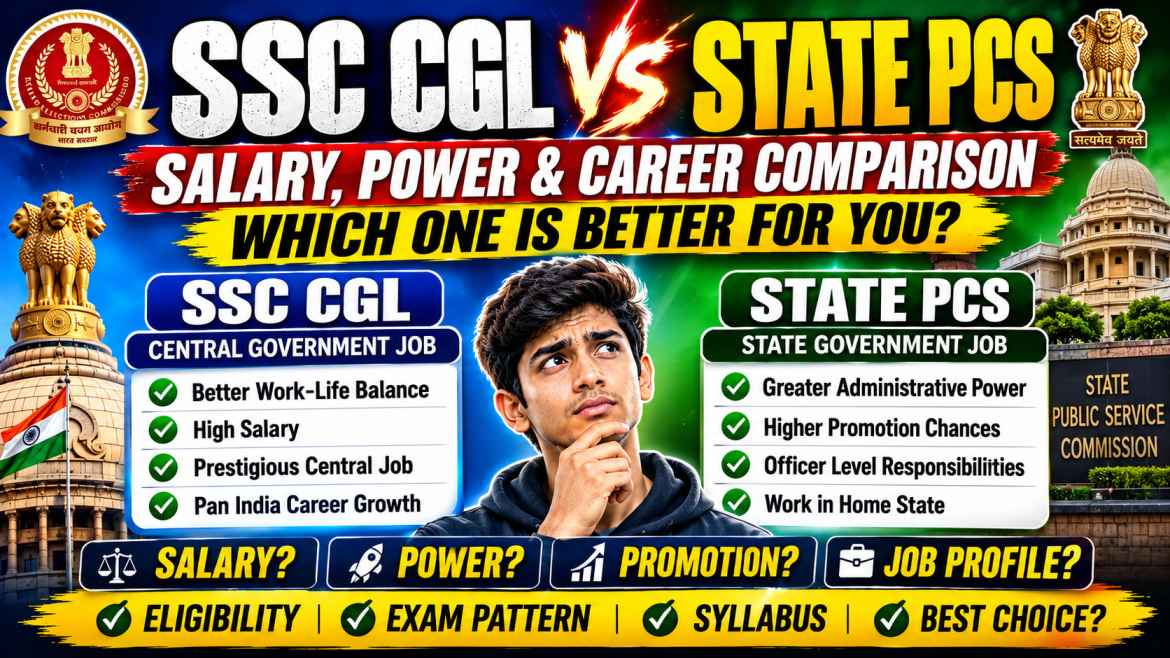
SSC CGL vs State PCS: Salary, Power & Career Comparison (2026 Guide) – Part 1
Every year, lakhs of government job aspirants face one of the biggest career dilemmas: Should I prepare for SSC CGL or State PCS? Both examinations offer prestigious government jobs, attractive salaries, and long-term career opportunities. However, the nature of work, authority, promotion, and selection process are quite different.
SSC CGL recruits candidates for various Central Government Ministries and Departments, while State PCS (Public Service Commission) examinations recruit officers for different State Government departments.
If you are confused about which exam is better for your career, this detailed comparison will help you understand the differences in salary, power, promotion, work-life balance, exam difficulty, career growth, and job profile.
SSC CGL vs State PCS Overview
| Feature | SSC CGL | State PCS |
|---------|----------|-----------|
| Conducting Body | Staff Selection Commission (SSC) | State Public Service Commission |
| Job Type | Central Government | State Government |
| Educational Qualification | Graduation | Graduation |
| Selection Process | Tier 1 + Tier 2 + DV | Prelims + Mains + Interview |
| Job Location | Across India | Respective State |
| Promotion | Good | Excellent |
What is SSC CGL?
The Combined Graduate Level (CGL) Examination is conducted by the Staff Selection Commission (SSC) to recruit graduates into various Central Government departments.
Popular SSC CGL posts include:
- Assistant Section Officer (ASO)
- Income Tax Inspector
- GST Inspector
- Assistant Enforcement Officer
- Auditor
- Accountant
- Tax Assistant
- Divisional Accountant
- Inspector (Various Departments)
These jobs mainly involve administrative, taxation, auditing, investigation, and office management responsibilities.
What is State PCS?
State PCS (Public Service Commission) examinations are conducted by individual states such as:
- UPPSC
- BPSC
- MPPSC
- RPSC
- HPSC
- UKPSC
- JPSC
- CGPSC
These examinations recruit officers for various State Government departments.
Popular State PCS posts include:
- Deputy Collector
- Deputy Superintendent of Police (DSP)
- Block Development Officer (BDO)
- Commercial Tax Officer
- District Supply Officer
- Assistant Commissioner
- Tehsildar
- Excise Officer
- Labour Officer
These posts generally involve administrative responsibilities, fieldwork, public interaction, and implementation of government policies.
Eligibility Comparison
| Criteria | SSC CGL | State PCS |
|----------|----------|-----------|
| Educational Qualification | Graduation | Graduation |
| Minimum Age | 18–20 Years (Post-wise) | Usually 21 Years |
| Maximum Age | 27–32 Years (Post-wise) | Varies by State (Generally 35–40 Years) |
| Nationality | Indian | Indian |
Both examinations require a bachelor's degree from a recognized university. However, the age limits and relaxation rules vary depending on the specific recruitment notification.
Exam Pattern Comparison
| SSC CGL | State PCS |
|----------|-----------|
| Tier 1 | Prelims |
| Tier 2 | Mains |
| Document Verification | Interview |
| Final Merit | Final Merit |
SSC CGL
- Tier 1 (Objective)
- Tier 2 (Objective)
- Document Verification
State PCS
- Preliminary Examination
- Main Examination (Descriptive in most states)
- Personality Test / Interview
- Final Merit
State PCS generally has a longer and more comprehensive selection process.
Syllabus Comparison
SSC CGL
The syllabus includes:
- Quantitative Aptitude
- English Language
- General Intelligence & Reasoning
- General Awareness
- Computer Knowledge
State PCS
The syllabus usually includes:
- History
- Geography
- Indian Polity
- Economy
- Environment
- Science & Technology
- Current Affairs
- Ethics (in many states)
- State-Specific General Knowledge
- Essay Writing
- Descriptive Answer Writing
Compared to SSC CGL, State PCS requires a much broader and deeper understanding of social, administrative, and governance-related subjects.
Difficulty Level
Many aspirants ask:
Which exam is more difficult?
SSC CGL
- Highly competitive
- Objective-type examination
- Strong Mathematics required
- Faster problem-solving
State PCS
- Multi-stage examination
- Descriptive mains
- Interview
- Extensive syllabus
- State-specific preparation
Overall, State PCS is generally considered more demanding because of its descriptive mains examination and interview stage.
Salary Comparison
| Feature | SSC CGL | State PCS |
|---------|----------|-----------|
| Starting Salary | ₹35,000–₹75,000+ | ₹45,000–₹80,000+ (Post-wise) |
| Allowances | DA, HRA, TA | DA, HRA, TA & State Allowances |
| Pension/NPS | As per Government Rules | As per State Government Rules |
Both career paths offer attractive salary packages. However, the exact in-hand salary depends on the post, pay level, city of posting, and applicable allowances.
Officer-level State PCS posts such as Deputy Collector or DSP often receive additional administrative responsibilities and benefits according to state government rules.
Job Profile Comparison
SSC CGL
Common responsibilities include:
- Office administration
- Tax administration
- Audit
- Accounts
- Investigation
- Government correspondence
- Policy implementation support
State PCS
Officer-level responsibilities include:
- District administration
- Law and order (for police-related posts)
- Revenue administration
- Public grievance redressal
- Development project monitoring
- Policy implementation
- Coordination with various government departments
State PCS officers usually have a wider administrative role and are directly involved in public service delivery at the district and state levels.
Work Pressure
The work environment differs significantly.
SSC CGL
- Mostly office-based work
- Fixed working hours in many departments
- Moderate workload
- Better work-life balance for many posts
State PCS
- Administrative responsibilities
- Field visits
- Emergency duties (depending on the post)
- Higher decision-making responsibilities
- Public interaction
State PCS officers generally handle greater responsibility, which can also mean higher work pressure.
Power & Authority Comparison
One of the biggest reasons candidates choose State PCS over SSC CGL is the level of administrative authority associated with many State PCS posts.
SSC CGL
SSC CGL officers perform important administrative, taxation, auditing, investigation, and departmental responsibilities. Posts like Income Tax Inspector, GST Inspector, and Assistant Enforcement Officer have significant powers within their respective departments.
However, their authority is generally limited to departmental functions and government regulations.
State PCS
Many State PCS officers exercise executive and administrative powers at the district or state level.
Examples include:
- Deputy Collector
- Deputy Superintendent of Police (DSP)
- Sub-Divisional Magistrate (SDM) (through promotion in many states)
- Block Development Officer (BDO)
- Commercial Tax Officer
These officers are responsible for implementing government policies, maintaining law and order (where applicable), supervising departments, and handling public administration.
Overall, State PCS generally offers greater administrative authority than most SSC CGL posts.
Promotion & Career Growth
Career growth depends on the department, vacancies, and service rules.
SSC CGL Career Growth
Typical promotion paths include:
- Assistant Section Officer → Section Officer → Under Secretary → Deputy Secretary
- Income Tax Inspector → Income Tax Officer → Assistant Commissioner
- GST Inspector → Superintendent → Assistant Commissioner
Promotion is stable, and employees can reach senior administrative positions over time.
State PCS Career Growth
Promotion opportunities are extensive.
A typical progression may be:
- Deputy Collector → Additional Collector → Joint Collector → Collector (subject to service rules and promotion policies)
- DSP → Additional SP → SP (as per service rules and vacancies)
Promotion timelines vary by state, cadre strength, vacancies, and departmental policies.
Work-Life Balance
| Feature | SSC CGL | State PCS |
|---------|----------|-----------|
| Office Hours | Mostly Fixed | May Vary |
| Weekend Holidays | Usually Available | Depends on Administrative Duties |
| Field Work | Limited (Post-wise) | Extensive (Many Posts) |
| Public Interaction | Moderate | High |
| Emergency Duty | Rare (Most Posts) | Common (Many Posts) |
Candidates seeking predictable office hours generally prefer many SSC CGL posts, while those interested in administrative leadership and field responsibilities may prefer State PCS.
Transfer Policy
SSC CGL
- Transfers depend on the department.
- Some departments provide long-term postings.
- Certain posts involve all-India transfer liability.
State PCS
- Transfers generally occur within the same state.
- Officers may be posted in rural, urban, or district headquarters.
- Transfers are a regular part of administrative service.
Job Security
Both SSC CGL and State PCS provide excellent job security.
Employees receive benefits such as:
- Regular salary
- Dearness Allowance (DA)
- House Rent Allowance (HRA)
- Transport Allowance (TA)
- Paid Leave
- National Pension System (NPS) or applicable state pension rules
- Medical benefits (as per applicable rules)
Both are considered among the most secure government career options in India.
Pros and Cons
SSC CGL
Advantages
- Central Government Job
- Better Work-Life Balance
- Office-Based Environment
- Attractive Salary
- Multiple Departments to Choose From
- Lower Administrative Pressure
Disadvantages
- Competition is very high.
- Promotions may be slower in some departments.
- Limited executive authority compared to many State PCS posts.
State PCS
Advantages
- Officer-Level Administrative Posts
- Greater Public Authority
- Strong Career Growth
- Respect and Responsibility
- Opportunity to directly impact governance
Disadvantages
- Larger syllabus
- Descriptive Mains Examination
- Interview stage
- Higher workload and field responsibilities
Who Should Choose SSC CGL?
SSC CGL is a good choice if you want:
- A Central Government job
- Better work-life balance
- Office-based administrative work
- Faster completion of the recruitment process
- Opportunities across multiple Central Government departments
Who Should Choose State PCS?
State PCS may be a better fit if you:
- Want officer-level administrative responsibilities
- Enjoy leadership and decision-making roles
- Are comfortable with field postings
- Can dedicate time to preparing for descriptive examinations and interviews
- Wish to serve within your home state or a specific state cadre
Frequently Asked Questions (FAQs)
Which exam is more difficult?
State PCS is generally considered more challenging because it includes a descriptive mains examination and an interview, in addition to a broad syllabus.
Which offers a higher salary?
Both provide attractive salaries. The exact in-hand salary depends on the post, pay level, allowances, and place of posting.
Which has more administrative power?
Many officer-level State PCS posts generally have greater executive and administrative authority than most SSC CGL posts.
Can I prepare for SSC CGL and State PCS together?
Yes. Subjects like General Studies, English, Reasoning, and Current Affairs overlap to some extent. However, State PCS requires additional preparation for descriptive writing and state-specific topics.
Which is better for work-life balance?
Many SSC CGL posts provide more predictable office hours, while State PCS officers often have greater administrative responsibilities and variable schedules.
Final Comparison
| Feature | SSC CGL | State PCS |
|---------|----------|-----------|
| Job Type | Central Government | State Government |
| Salary | ⭐⭐⭐⭐☆ | ⭐⭐⭐⭐☆ |
| Administrative Power | ⭐⭐⭐☆☆ | ⭐⭐⭐⭐⭐ |
| Promotion | ⭐⭐⭐⭐☆ | ⭐⭐⭐⭐⭐ |
| Work-Life Balance | ⭐⭐⭐⭐⭐ | ⭐⭐⭐☆☆ |
| Exam Difficulty | High | Very High |
| Interview | No | Yes |
| Best For | Administrative Central Govt Jobs | State Administrative Officer Roles |
Final Thoughts
Both SSC CGL and State PCS offer outstanding government career opportunities, but they are designed for different career aspirations.
If you prefer a Central Government job, structured office work, stable work-life balance, and a faster recruitment process, SSC CGL is an excellent option.
If your goal is to become an administrative officer with leadership responsibilities, greater executive authority, and direct involvement in governance, State PCS can be the more suitable path. It demands a broader preparation strategy and a longer selection process but offers significant opportunities for public service and career advancement.
Ultimately, the best choice depends on your interests, strengths, and long-term career goals. Choose the examination that aligns with your aspirations and prepare with consistency and dedication.